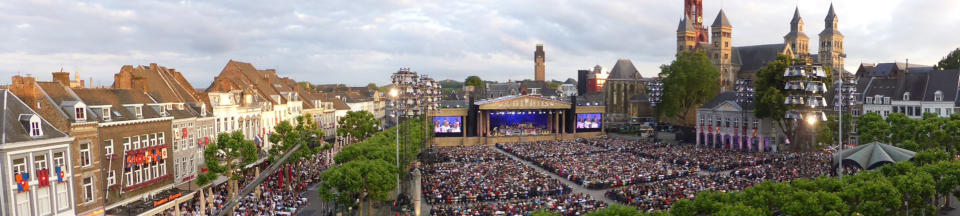
ANDRERIEUMOVIES.COM

Pierre Rieu (7)
June 2026



June 21, 2026
De Limburger, Joos Philippens,
photos from de Limburger and Chapeau Magazine.
Translation: Ineke, edited by Diana D. Le
War-torn past inspires Pierre Rieu:
'I want to dedicate myself to peace, because the world is on fire'
Pierre Rieu, son of the famous violinist and orchestra conductor André, is working on an
"experience about peace". A key driving force is his family history, with a Jewish grandfather and a
grandmother in the resistance.
"My grandparents' fears have been passed on in my DNA."
"What does this remind you of?" Pierre Rieu asks with great interest. We are standing in a recreated café
that looks like the set of the 1980s TV series Allo, Allo, which satirized both the Nazis and the French
resistance.
“Uh, to be honest, I think of Allo, Allo."
Rieu responds enthusiastically: “Exactly right! Look, there hangs the Rue Nouvion sign. Up here, we are
going to recreate Madame Fanny La Fan’s bedroom.”
The café set is located in a warehouse on the outskirts of Maastricht, where Rieu has been collecting
military equipment for many years. A tank, Jeeps, Humbers, trucks, and an amphibious vehicle. A
remarkable passion for — or is it an obsession with? — war. Where does that come from?
The passion turns out to be deeply rooted. Pierre’s grandfather was German and Jewish. “A difficult
combination, with his German accent, before, during, and after the war. He came to Maastricht in 1933,
when Hitler seized power. His brother volunteered for deportation and was gassed within eight days.“ As a
child, Pierre always leafed through photo albums about the Second World War at his grandparents’ house.
During his high school years, for a history project, he ended up just across the border in Belgium, at Fort
Eben-Emael, the "impregnable" fortress that the Nazis captured with gliders during World War II. Rieu was
already giving tours there at the age of 16. What deeply affected him was a visit from two German
commanders who had landed at the Fort at the time. "I had photos of them with Hitler. Now I was standing
face to face with them, shaking their hands. Suddenly, it all hit very close to home. Just a handshake away
from Hitler. But still. Those two were professional soldiers, not Nazis. Not every German was inherently evil;
just take my grandfather, for instance. That’s why we in our family are careful not to generalize. Speaking
about people as a group is very dangerous. 'Do you want more or fewer Moroccans?' It makes my hair
stand on end."
At 18, Rieu bought a Willys Jeep, the beginning of his military collecting obsession. "I have a fondness for
mechanics, I fixed up that Jeep, and then things got a little bit out of hand." Understatement of the week,
amidst the collection of tanks, Jeeps, Humbers, and military trucks. He roars with laughter.
Turning Point
As a teenager, Pierre was a different person. The intention to do something for peace, as he does now at
44, was far off back then. "I just thought it was cool to drive around in a Jeep like that." His friendship with
American war veteran Frank Towers marked a turning point. Towers, who helped liberate Maastricht, saw a
train with sealed wagons in East Germany in 1945 while serving as a soldier. Inside, he found 2,500 Jews
whom the Nazis had left behind during their flight from the Bergen-Belsen concentration camp. That was
horror. Towers made it his life's work to track down as many survivors from that train as possible. In 2011,
there was a commemoration in Israel. Towers asked his friend Pierre to go along as a buddy. "That
gathering was so incredibly emotional. Those people coming face to face with their liberator. Unbelievable!"
Afterwards, Pierre struck up a conversation with an Amsterdam woman who had been on that train. They
also talked about Pierre’s family. Her husband asked: “What was your grandmother’s name?” At the name
Nelly Eijmael, something special happened. The man grabbed Pierre’s cheeks and didn’t let go. “My boy!
I am alive thanks to your grandma! You are the first person I can thank. I was in hiding in Maastricht, where
she took me from place to place.” Pierre couldn’t believe what he was hearing. “I often stayed with my
grandparents, but that was never spoken about.” (Article about Nelly Eijmael, click HERE).
A few years later, he was back in Israel with his father’s orchestra, where he heard over the walkie-talkie
that someone had a gift for him. I said, "'Just take it.’ Not out of arrogance, but I was very busy. Then I
heard, ‘It’s about your grandmother.’ That changed everything. I ran outside. A woman had a photo of my
grandmother with the entire resistance group."
Betrayed
That group was betrayed at the end of the war; many were executed, but his grandmother survived.
Warned by a cousin who worked for the PTT, eavesdropped on conversations, and announced raids. Pierre
didn't know. It explained a lot in one fell swoop; for a long time, he struggled with inexplicable fears. "Now I
knew: their fears have been passed on in my DNA." Something just clicked. "I want to dedicate myself to
peace, because I see that the world is on fire. To quote 'Soldier of Orange': if we do nothing, who will?" He
is doing something, and that gives him a good feeling. "At least I am trying."
Two years ago, it finally clicked when he was speaking with his daughters. "The standard term 'Stop War'
has become like an oil light in your car. If it lights up, you have to go to the garage. You forget about it, and
after three months, you don't notice that light anymore. Until your car breaks down."
Knot
“That 'Stop War' has existed for a hundred years. It’s nice that people hang posters behind their windows,
but it doesn’t incite action. With my daughters, I turned that into a question: 'Why stop peace?' Next, we tied
a knot in the barrel of my tank."
Two years ago, his group drove twelve renovated vehicles through Son en Breugel (town), including the
tank tied in a knot. “They were all military purists there. I felt the tension surrounding that knot. We handed
out bags, stickers, and even condoms with the logo Why Stop Peace? And beautiful conversations got
going. Eventually, they understood. But that knot, too, is an outdated symbol. When we do memorial rides
again in September around the liberation of Limburg, that knot will be out. That really hurts me, but I realize
that it doesn't work anymore. I no longer support it."
Pacifism alone is pointless, that is the lesson he has learned. "There are more tanks here in the warehouse
than the Dutch army has. Seriously. They were all sold to Argentina. Hopefully, we have learned from that
naivety. You have to show muscle to scare off aggressors. I am 100 percent anti-war, against violence; you
won't see me angry often, let alone hit someone, but you have to take precautionary measures. A world
without war and aggression is nonsense. No more knots in the barrel, then. That is impossible, while we
are spending billions on defense and are essentially in a Third World War."
Technology
The café from Allo, Allo is the gathering place for the forty volunteers who help Rieu in the warehouse.
“I can spray paint and weld cars a bit, and I know a bit about engine mechanics. Enough to figure out who
we need for which problem. It is a group of friends. Fathers with sons, a notary clerk, an ENT surgeon,
someone from asbestos removal, welders, mechanics, farmers.”
For Pierre Rieu, being together on Wednesday evenings and Fridays is pure enjoyment. “I really enjoy
sharing. Sometimes we just talk. Believe me, I am never alone here.” The military vehicles can only be
visited by invitation or by schools that sign up. “I don’t want a museum where eighty headlights stare at you.
That tells nothing; it is only fun for vehicle enthusiasts. Discussions about the wrong screws and such.”
Through Why Stop Peace, Rieu came up with the idea of a Peace Experience. “I come from the
entertainment industry. Children should leave here with the feeling: that was cool! It won’t be an
amusement park. The point is to get the conversation flowing at home as well."
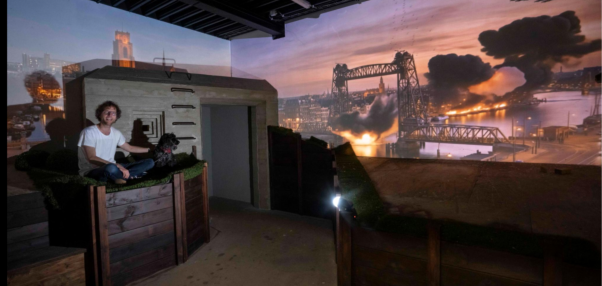
Rieu devised fifteen scenes, full of digital spectacle, three of which are already completely finished in the
warehouse. Two are still under construction. We walk up a staircase in the warehouse, the entrance to the
Experience. Wow, two entire walls of images of a (non-existent) South Limburg village immediately
overwhelm you. Suddenly, the images transition into the bombing of Rotterdam. Bomb impacts. Fire
explosions. Machine gun salvos. Sirens. Soon the floor will shake too, and debris will come from the ceiling.
"All your senses are screaming, 'I have to get out of here!' But the group leader stays put. And so do you",
Rieu explains. The lesson: how is it possible to have so much trust in someone you have only known for
ten minutes?
Next, we pass through a bunker to a realistically recreated alleyway with a mini-theater, where the
Deutsche Wochenschau (German Newsweek) is being shown. Original black-and-white footage of a mass
speech by Adolf Hitler. A huge shock. Suddenly, the reporter recognizes himself, large on the screen,
looking around with a bewildered expression. "Hey, that's me!!" Rieu is very pleased with that shock. "You
saw my preview during Memorial Day; you knew what was coming, right? You know me a little, don't you?"
Well, apparently not well enough.
At that gathering in the town hall in Margraten, children looked in amazement at the footage from a film in
which they saw themselves. But the fact that Rieu has now used AI to edit the reporter into the film... It
makes an impression. "Your attitude during that speech by Hitler would have meant a one-way trip to a
concentration camp," says Rieu. "How do you translate that feeling into the world of a high school student?
Do you look away when a classmate is being bullied? Do you join in? Or do you confront the bullies? Do
you comfort the victim afterwards?" In every scene, someone from every group of visitors pops up in this
way. "That's how you keep the attention. 'Who among us is going to appear in the next scene?' After the
nearly hour-long Experience, there has to be a half-hour debriefing."
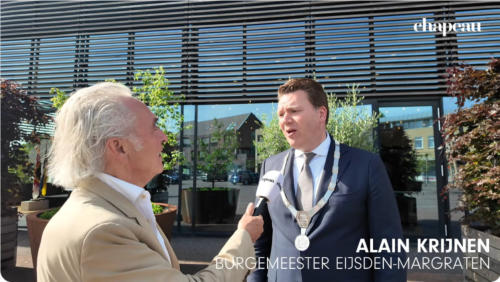
The Experience was supposed to provide Maastricht with a new educational attraction. That is, until former
Mayor Gerd Leers, the founding father of André Rieu's Vrijthof shows, came forward and put Pierre in touch
with Mayor Alain Krijnen of Eijsden-Margraten. The latter was impressed by the embryonic Experience
Center. "All well and good," said Krijnen, "but this naturally has to be in Margraten, the site of the American
cemetery." "Out of the question," responded Pierre Rieu, although he immediately realized the power of the
combination in Margraten. He was also apprehensive about the reaction of his volunteers. They surprised
him. Unanimously, they said: "Fantastic!" That was a wonderful feeling. Pierre Rieu put his "chauvinistic
ego" aside. He is proud of that. "It is not about me. We developed the technology for the Experience with
Submedia from Heerlen. Is someone copying it? That is the only thing I am proud of. At least, if it is used in
the right way."
So, his current Experience under construction is becoming a prototype for the "real" one in Margraten,
which, as far as Pierre is concerned, should be ready within five years. The municipality of Eijsden-
Margraten is in charge of that multi-million project. Funders can already see here what to expect.
Rieu realizes that he will still have to deal with plenty of 'shit'. After the first publications about the
Experience, comments appeared on social media such as, "Do those vultures have to profit from the
Second World War now too?" He doesn't want a cent for it. "I am the founding father, I want to continue
contributing ideas, but I don't need to be mentioned later. That is absolutely not what it's about for me."
Criticism
The cheap criticism only made Rieu more steadfast. "Never judge, never reject. Always engage in
dialogue. 'Your strong language touches me; I am curious where it comes from.'" He had to learn that.
"Where judgment begins, observation ends. Man, I used to get into such heated arguments with my father!
Now I say, ‘That’s interesting what you’re saying.’ So help me understand you. And then, possibly, ‘You’re
right.’”
Pierre also applies this attitude to his father's concerts, the travel agency, and his hotel on the Onze-Lieve-
Vrouweplein. "I select the staff myself. They must delve into each guest individually, not settle for standard
platitudes. See the individual person. Mindfulness, for years Pierre considered that 'airy-fairy nonsense'.
"Until I experienced, I needed it myself. I honestly tell people, 'That remark touches me.' It's not a trick,
almost a way of life. I have never been so close to myself as I am now. It makes life so much more
pleasant."
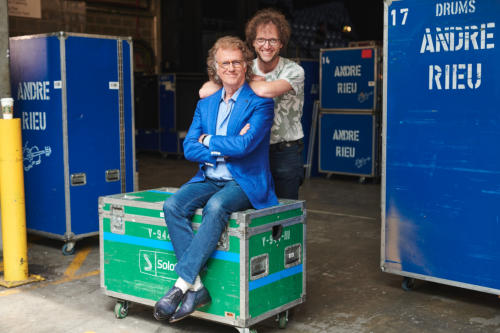
Pierre Rieu and Flo at a war scene in his "Peace Experience" exhibition, currently
under construction in Amby, Maastricht, Netherlands in June 2026. © Harry Heuts.
André Rieu's Son Suffered from Working for His Father:
"I Went Through Therapists"
August 3, 2026 article from NOS TV, Nieuwsuur.
Yvonne Roerdink, Reporter
Justus Visser, Editor, Nieuwsuur
Translated by Diana D. Le
Behind every famous performer, artist, or chef stands someone who makes that success
possible—unconditionally. In our series 'Out of the Shadows', we put those people in the spotlight.
This week: Pierre Rieu.
Pierre Rieu, André Rieu’s son, has struggled with his father’s career. He shared this with Nieuwsuur during
the 20th anniversary of the iconic summer concerts at the Vrijthof in Maastricht. Starting at the age of
nineteen, he played a key role in André Rieu’s career as technical director and later as a concert producer.
André Rieu is the Netherlands’ most famous violinist and orchestra conductor. Believing that no one could
do it better than his son, Pierre was given an important role in the orchestra at an early age. “I was 19 when
I joined the company, and that’s when my parents appointed me as technical director,” he says.
A Challenging Time
One of Pierre’s most important tasks is protecting his father. “Not just physically, by literally keeping people
away from him. In business matters, too, I’ve always tried to shield him as much as possible from anything
that isn’t related to music.” Taking on a fatherly role for his own father has taken a heavy toll on Pierre.
“Young children aren’t supposed to have to take care of their parents. And that’s exactly what I’ve done.”
André Rieu acknowledges this division of labor. “Making things big is my job. But being sensible—that’s
Pierre’s job.” Pierre: “There was no one who could do it better than me. What my father really meant by that
was: 'There’s no one I trust more than Pierre.' That weighed heavily on me: okay, so apparently, I can do
this.”
"My father works incredibly hard himself, so it’s almost a given that you’ll do the same when you work with
him. It’s not a requirement, but the dynamic is such that if you project that attitude, you get it back in return."
Pierre was given a major responsibility as a director at a young age. It was a tough time. For example, he
dropped out of law school. Because of the responsibility, he struggled with mental health issues. “I really
had to work through that. I went through a lot of therapists.”
The Drive to Prove Ourselves
During those difficult years, Pierre also sees how he and his father eventually reconnected with their
passion. “We both had to find our own way back to our roots—me to the business and him to music. We’ve
talked a lot about that, and we’re both really enjoying ourselves again right now. We also often tell each
other that we’re doing really well. What we’re doing here is truly extraordinary.”
Will the work ever end? Pierre doesn’t expect his father to stop anytime soon. He believes his father’s
intense drive to prove himself stems from his childhood. “He was belittled so much by his parents as a
child.”
When André Rieu graduated from the conservatory, his mother reportedly told him, “In the land of the blind,
the one-eyed man is king.” Pierre thinks experiences like that still drive his father forward.
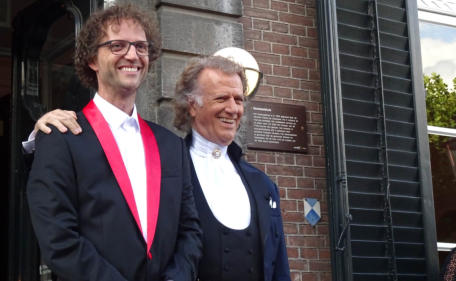
© Sally Hodges
July 2026. NOS TV, Nieuwsuur (NU). Duration video: 6,50 minutes. Transcript: Diana/Ineke.
Behind every famous performer, artist, or chef stands someone who makes that success
possible—unconditionally. In our series 'Out of the Shadows', we put those people in the spotlight.
This week: Pierre Rieu
It is the 20th edition of the André Rieu concerts at the Vrijthof.
During these days, his son Pierre ensures that André’s VIP guests want for nothing.
Before the show, Pierre gives a tour of his father’s castle.
Pierre Rieu greeting the VIP guests of André Rieu's castle tour: "Hello. Hello. Welcome."
Pierre asking a familiar André Rieu fan: "Can I have a hug?"
Pierre addressing the VIP guests: "I am Pierre. I am the younger son of André Rieu. More than a hundred
nationalities traveling to Maastricht this summer to see my father and his orchestra perform."
NU: You have to be willing to spend over €1,000, but you certainly get your money’s worth: the best concert
seats and a selfie with—arguably—the second most popular person in Maastricht today.
Guest: "You really have to take a photo with André Rieu, but this is perfectly fine too."
PR: "Well, enjoy it."
Guest: "You are just... yes, actually perhaps even more important."
PR: "Just say that for a moment [pointing to the camera]. No." [laughing]
NU to guest: "Is this your first time?"
Guest: "No, No. I’ve been here many times."
NU: "How many?"
Guest: "I have lost track. I come every year to the Vrijthof."
Pierre taking selfie with a couple of André Rieu VIP guests during the castle tour: "Lovely."
Guest: "Thank you so much."
PR: "Thank you so much for being here."
Guest: "May we ask you something? We could do with your father at home in England."
NU: André Rieu is not just an artist but also a multi-million-euro enterprise with global success, featuring
merchandise ranging from just about anything you can imagine.
PR: "I don't think we have underwear, but apart from that, we have pretty much everything else."
NU: That immense popularity means there are constantly people who want something from his father.
Pierre speaking to a sales prospector: "If we are interested, and if you write it down, we will contact you."
One of Pierre’s most important tasks is protecting his father.
PR: "Yes, I’ve been doing that for a long time. And not just literally—trying to keep people away from him
when the timing isn’t right—but especially professionally, shielding him from questions that have nothing to
do with music."
NU: "Because usually it is the other way around, that the father is the one protects his son."
PR: "Yes, that's right. Are you familiar with the term parentification? Ha. Ha."
NU: "That’s not always considered a good thing in psychology."
PR: "No, certainly not. And I think it definitely applied in my case. But it all happened out of love. They never
had any malicious intent in giving me so much responsibility at a young age. It just evolved that way. I won't
say that he left his mark, but it did have an impact on my life.
"Young children are not supposed to take care of parents, never."
NU: "But that is what you did."
PR: "Yes, that is what I did, yes."
NU: "The square is slowly filling up, and standing next to me is Pierre—the son of….
"Hi, how are you doing—but more importantly, how are your father's nerves?"
PR: "You’d have to ask him, but I think I can gauge it pretty well: they’re racing through his body right now."
NU: "Thank you very much. Go ahead and enjoy it."
PR: "I'll definitely do that."
NU: "Okay, very good."
PR: "Thank you very much."
NU: "We are going to enjoy it here too."
PR: "You heard the instruction in your earpiece to wrap up the conversation."
NU: "Yeah, you know how it works. Enjoy."
NU: André Rieu’s success seems like a given, but times weren't always golden. Just as Pierre was starting
his studies, his father’s company was on the verge of bankruptcy. Pierre felt he had no choice. He dropped
out of his studies to help his parents.
PR: "I had a wonderful childhood—truly wonderful. But after that, it became... Well, when you’re that young
and have so much responsibility thrust upon you, it’s tough. I was 19—basically still a child. I remember
sitting alone in my hotel room in New York, planning a tour we were going to do there. All by myself, and I
was homesick. I really wanted to call my mother, but I couldn't get through to her at that moment. I was in a
total panic."
NU: "And lonely."
PR: "Yes, I felt very lonely then."
It was only much later that Pierre realized the impact of his father’s dream on him.
PR: "I started working on it right away. I’ve been through a lot of therapists! Ha, ha."
PR: "We’re going backstage for a moment. A sneak peek."
NU: "Has it never been your dream to stand on the stage yourself?"
Pierre paused before answering: "No. No."
NU: "Sometimes it seems like you are the only ones left who want to prove more. Is there a moment when it
is enough?"
PR: "No, never. Especially not for him.
"As a child, he was constantly belittled by his parents. After his conservatory final exam, he asked his
mother: 'What did you think of it?' Her answer was: 'In the land of the blind, the one-eyed man is king.'
"To be sent out into the world with that—with an upbringing like that...
"He is still proving himself; I’m certain of it!"
PR (prior to the concert in the Theater): "Hi, Dad"
PR to the interviewer: "Are you keeping a bit of distance?"
NU: "Yes."
PR: "Right there is fine."
NU to André: "Could it be this big without Pierre?"
AR: "Well, at least he made sure of it. That we make a profit from it."
NU: "Financially?"
AR: "Yes, because when you say "big," that’s my department. And being sensible—that’s his department."
Pierre in front of the Theatre-steps: "For Dad, this is a kind of recharging moment. What athletes often do.
He really does that, to already get a bit of a feel for the audience."
Fan Hanne (from Germany): "It's really great to be here again, and I will enjoy 11 out of 12 concerts this
year." Fans Liz and Edwina: "We come from Australia, she (Anna) from Malta, and they (Sally and Judy)
from the UK."
NU: "Do you like André, or do you love him?"
Edwina: "We love him. We looove him!"
Fan: "Wonderful. Wonderful. Fantastic!"
NU: "Why do those people go here every time?"
PR: "They are building memories together. I find it actually moves me, too."
NU: "Why does it move you?"
PR: "Yes, that is really special if you choose to celebrate something with your loved one and then you
choose to go to see my Dad with his orchestra and then to experience this.
"I said it at the beginning, it is really very special, and I really feel that way too."
André Rieu responds to emotional statements by his son Pierre
In the summer series *Uit de Schaduw* on Nieuwsuur, Pierre Rieu looked back emotionally on the
period when his father's company was in serious financial trouble (read the articles below).
André responds on *Shownieuws* about how he viewed his son's statements.
Translated by Ineke/Diana.
August 25, 2026. Shownieuws. Video: 02:46. Translation Ineke/Diana
Shownieuws presenter Tooske Ragas: "You recently spoke to André Rieu about that intimate interview
Pierre recently gave to Nieuwsuur for the program 'Uit de Schaduw', in which he talked about his
experiences from his youth."
Shownieuws presenter Lieuwkje Dijkstra: "Indeed. Pierre said there that he was given a huge
responsibility for the orchestra at the age of 19. At that time, it was on the verge of bankruptcy, and he
ensured that a new direction was taken. He said that it did change his relationship with his parents and
that he had a lot of therapy afterward. He presented himself as very vulnerable and very open, and we
haven't seen that side of him yet. I asked André Rieu how he viewed that interview."
André Rieu: "Oh, I was very surprised."
Shownieuws: "The interview mentions that Pierre was forced to drop out of his studies to help the nearly
bankrupt family business. But that is not the whole story."
AR: "He studied law for 3 weeks, when he told Marjorie that he didn't like it at all. Marjorie had said then:
'Then just come and join us!' That is basically how it went."
Sh.n: "Pierre said that he had to bear a lot of responsibilities at a young age."
Pierre Rieu: "I was 19, still a child, when I was sitting all alone in a hotel room in New York planning a tour
we were going to do. I was terribly homesick. I wanted to call my mother, couldn't reach her, and
panicked."
Sh.n: "Feeling lonely?"
PR: "Yes, I felt pretty lonely back then."
Sh.n: "Pierre realizes that he had to sacrifice a lot for his father's dream."
PR: "I did get to work on it right away: I went through a lot of therapists, ha ha."
AR: "Pierre is very open about everything. I actually am too. He got that from us. I am very happy that he
is so open, because otherwise it turns into a secretive business."
PR: "I had a wonderful childhood, really. But after that, it became really tough when you are assigned so
much responsibility at such a young age."
Sh.n: "Despite everything, his dedication is still of great value to the André Rieu brand."
AR: "We owe Pierre so much. Marjorie and I only look at the result of a show, whatever the cost. Pierre
says every now and then… 'Um… do you know how much that costs??'
He has done so much in recent years, arranged everything regarding music rights, record labels….
Everything we don’t feel like dealing with. He took care of all of that for us."
Shownieuws presenter Bram Moszkowicz: "You can see a proud father talking about his son with so
much love there."
The other Shownieuws presenters agree with him: "Absolutely, you can see that."



- Maastricht Dinnertime
- Maastricht Preparations
- Tickets & accomodation
- Ticket Mediation
- Trains from Amsterdam Schiphol
- Trains from Brussels, Paris, Frankfurt and London
- Maastricht Fan Dinner
- Maastricht Fan Picnic
- Maastricht City Walks
- Maastricht Mosasaurus
- Daytrips from Maastricht
- Vrijthof news
- Maastricht Bonbonniere
- Maastricht ENCI quarry

- 2026 - 2030
- 2021 - 2025
- Previous items 2025 Jul - Dec
- Maastricht 2025
- Previous items 2025 Jan - Jun
- Previous items 2024 Jul - Dec
- Index of this period
- Doctor Peter de Beer
- Phil Bee
- Carlo Bonnie
- André’s Castle De Torentjes
- André gets his own stamp
- Typewriter artist
- Duo X-Elle
- Cinema experience 2024
- Quote Business Magazine
- Concerts in Bogotá, Colombia
- Margriet Magazine (1)
- Margriet Magazine (2)
- André Rieu turns 75
- André’s 75th birthday party
- Concert in Milano
- Roadsoap 5
- Presentation of second biography
- Het Financieele Dagblad
- 2024 Christmas concerts
- Interview with Marjorie
- Interview with André Rieu
- Interview from Nous Deux
- Dorona Alberti looks back
- Maastricht 2024
- Previous items 2024 Jan - Jun
- Index of this period
- Kimberly Smith
- Amsterdam New Year's concert
- MAX Magazine
- Stradivari instruments
- Golden Carriage
- Bahrain concert
- Ineke's book
- Emma's birthday in Greece
- Organic carrots
- Mexico Illness
- New animated series
- Trio SAAMN
- Andre Rieu in cinema 2024
- Sculpture of Andre Rieu
- Making of the bull
- Book 75 year Andre Rieu
- Previous items 2023 Jul - Dec
- Maastricht 2023
- Previous items 2023 Jan - Jun
- Previous items 2022 Jul - Dec
- Index of this period
- December with André
- Ivo on Sunday
- World Record Academy
- Privé / Telegraaf
- Two Vienna concerts
- Pierre Kartner (Father Abraham)
- Shellfish from ENCI quarry
- Zagreb concert
- Great Maastricht Dictation
- South America Tour
- Tribute to Queen Elizabeth II
- Rose Festival in Lottum
- Photo exhibition William Rutten
- Fake tickets on sale
- L1 interview
- Rieu and the Royals
- Interview with Pierre Rieu
- Efteling News
- Announcement Christmas concerts
- Boundlessly popular
- Maastricht 2022
- Previous items 2022 Jan - Jun
- Previous items 2021 Jul - Dec
- Index of this period
- LINDA's Winterguests
- Max Verstappen World champion F1
- Lisbon concerts
- Christmas cinema movie
- Koffietijd program
- Christmas concerts 2021 postponed
- Mindfuck
- ARD1, Club1 program
- Promoting Portugal tour
- Limburg Central article
- Andre's birthday
- Kingsday 2022 in Maastricht
- Podcast: weird hit wonder
- NDR talkshow
- 10 Christmas concerts in the MECC
- Vera Russwurm interview
- Flooding benefit program
- Humberto interview
- Flooding in Limburg
- Two best friends, Andre and Andre
- Previous items 2021 Jan - Jun
- Index of this period
- Maastrichts dialect
- Playing again!
- OP 1 Interview
- Vrijfhof 2021 concerts postponed
- Covid Vaccinations
- EVC Congress
- Julia and Kathy
- L1 Interview
- 3 AW Nights interview
- Dutch Bake-Off
- Chinese Interview
- Rijsemus Violin builder
- Al-Jazeera Interview
- Blaaskracht
- PRESS info
- Happy New Year
- 2015 - 2020
- Previous items 2020 Jul - Dec
- Previous items 2020 Jan - Jun
- Previous items 2019 Jul - Dec
- Maastricht 2019
- Previous items 2019 Jan - Jun
- Previous items 2018 Jul - Dec
- Maastricht 2018
- Previous items 2018 Jan - Jun
- Index of first half 2018
- June 26th, VNG Congress
- May 13th, Duckrace
- May 12th, Professor Scherder
- May 11th, Time for Max
- Bulgaria concerts
- Fake Rieus
- April 2018, Tel Aviv
- East USA Tour
- MDR Um 4, March 26th,2018
- May 9th, Sandy beach radio
- Universal Music Award
- Semper Opern Ball
- New Years Concert Amsterdam
- Previous items 2017 Jul - Dec
- Lift-Off Splash Percussian School
- Index of 2nd half 2017
- Carmen Nebel show
- Christmas Events 2017
- Interview with Frank Michael
- Celebrity Radio interview
- UK Tour 2017
- USA Tour 2017
- German Tour 2017
- Q&A with fans on Facebook
- Sunday Night Interview
- Mexico Donation
- Day-Time in Maastricht
- RTL Helemaal het einde
- ARD Brisant
- NDR Tietjen and Bommes
- Making of Cinema video
- Maastricht 2017
- Previous items 2017 Jan - Jun
- Index of first half 2017
- Interview with Steven Wright BBC2
- Portrait of a Passion
- The "Real" Andre Rieu
- Welcome to my World 2
- Double interview Andre Rieu and Jo Cortenaedt
- Mirusia "From The Heart"
- Larura Engel "En Canto"
- Refugee brought Andre Rieu success
- Carla Maffioletti "A Dream"
- Venetian Carnival Revelers
- Golden Oldie from 1985
- Agnes Fizzano's shop
- Carnival speech Mayor of Maastricht
- Maastricht Pastry Route
- 2017 Valentines day
- Rieu plays in Semper Oper Dresden
- Linda Custers, Princess Carnaval
- New Years concert Ziggo Dome
- Ziggo Dome rehearsal
- Previous items 2016 Jul - Dec
- 2016 Jul - Dec, Index
- SBS6 Stars Surprise Show Dec 21st, 2016
- Liverpool december 2016
- Magic Maastricht 2016
- BBC Breakfast Today Show
- ARD Advent Show
- Two Million Likes
- CinemaLive Christmas
- SWR 4 German TV
- Strictly Come Dancing
- The meaning of life
- Leute Heute
- Dancing with the Stars
- In Conversation
- Free Mini Concert in Maastricht
- L1 Radio Interview
- Josti Band 50 years
- NDR Talk Show
- New Maastricht Salon orchestra
- Rieu in Cinema
- Maastricht 2016
- Previous items 2016 Jan - Jun
- Previous items 2015 Jul - Dec
- 2015 Jul - Dec, Index
- Rieu entertainment
- Dec. 2015, Bild Star Magazine part 4
- Dec. 2015, Bild Star Magazine part 3
- Dec. 2015, Bild Star Magazine part 2
- Dec. 2015, Bild Star Magazine part 1
- Nov. 17th, 2015, RTL Boulevard
- Nov. 12th, Shownieuws
- Nov. 16th, Loose Women
- Oct. 30th, Colectiv Club Fire, Bucharest
- Roman Holiday (3)
- Roman Holiday (2)
- Roman Holiday (1)
- Oct. 26th, Classic FM Q&A
- Oct. 23rd, MDR at 4 PM
- Oct. 10th, Jubilee Award
- Sep. 19th, 2015, Carmen Nebel
- Maastricht 2015
- Previous items 2015 Jan - Jun
- 2015 Jan - Jun, Index
- Code M, the movie
- Bucharest Concerts Part 1
- Bucharest Concerts Part 2
- A Latin Breeze
- Maestro without borders
- Copenhagen Concert
- Brazilian Fans
- George Harper In Memoriam
- Press Conference Romania Open Air Concerts
- RTL Late Night Show
- AvroTros TV Show
- Cologne Concert
- Valentine's day
- Tempeleers Carnaval Medal
- Markus Lanz Talk Show
- 2007 - 2014
- Previous items 2014 Jan - Jun
- Maastricht 2014
- Maastricht 2014, The Preparations
- Maastricht 2014, (Dress) Rehearsal
- Maastricht 2014, The Concerts
- Maastricht 2014, Fan Dinner
- Maastricht 2014, Three Fan Picnics
- Maastricht 2014, Lift-Off
- Maastricht 2014, Exhibition Marc Rieu
- Maastricht 2014, Our Story Page 1
- Maastricht 2014, Our Story Page 2
- Maastricht 2014, Venetian Carnival, the making of
- Previous items 2014 Jul - Dec
- Previous items 2013 Jul - Dec
- Advent Calendar 2013
- Spirit of Christmas
- Nelson Mandela
- Movie Marina
- BBC Breakfast Show
- German TV programs (1)
- German TV programs (2)
- L1 Late November 5th, 2013
- RTL Boulevard, October 31st, 2013
- Amira Willighagen
- Evenblij with....
- Australian tour 2013
- German TV Sept.2013
- ORF Vera Russwurm
- Jean-Philippe composes ode to Mary
- Tietjen and Hirschhausen 2013
- Rieu to play on North Pole?
- Maastricht 2013
- Previous items 2013 Jan - Jun
- RTL Boulevard June 19th, 2013
- Jean-Philippe's children's books
- What I know about women
- AR-Academy
- Copenhagen concert
- SkyArts2
- Limbourgeois April 30th
- The making of the Coronation concert
- King's inauguration Day 2
- King's inauguration Day 1
- King's Waltz
- Charity TV broadcast
- classicFM interview
- Trini Lopez
- Jean-Philippe's book
- Jermaine Jackson
- Dutch Queen Abdicates
- history fan websites
- Cologne, Jan.1st 2013
- Previous items 2012 Jul - Dec
- Limbourgeois 25 December 2012
- Chistmas in Birmingham
- Linda Magazine, December 2012
- Advent calendar
- Cinema Heerlen 2012
- Boulevard Nov 21, 2012 and Ajax
- André's Birthhouse
- UK TV Programs November 2012
- Classic Brit Award
- Andre in Brazil 2012
- Interview Dolman Rieu
- BVN Trophy 2012
- Westland Fruit and Flower parade
- L1mbourgeois August 19, 2012
- Maastricht concert 2012
- Previous items 2012 Jan - Jun
- Previous items 2011 Jul - Dec
- Maastricht 2011
- Previous items 2011 Jan - Jun
- The person behind the phenomenon
- Andre and Hopkins
- Interview in Vienna
- Frank Steijns and "Normaal" band
- PBS visiting Maastricht 2006
- Amsterdam ArenA 2011
- Pierres Hobby
- DWDD May 26th, 2011
- Madiwodovrijdag show
- André Rieu and Anthony Hopkins
- Mirusia DVD release
- Scary moments in South Africa
- BUMA Export award 2010
- Interview with Mirusia
- WDR swap reporter
- Previous items 2010 Jul - Dec
- Platin Tenors at the Cologne Christmas market
- Koffietijd December 20th, 2010
- Christmas concert by Mirusia
- Today Show December 18th, 2010
- Ice Sculpture Maastricht 2010
- The André Rieu Story
- UK November 2010 appearances
- Mexico City, November 28th, 2010
- Ivo Niehe interviews André Rieu after his illness
- André is Back!!
- LeuteHeute 151110
- André is rehearsing again
- First interview after sickness
- André cancels UK and Aussie 2010 tour
- Jubilee book 30 years André Rieu
- Interview with Pierre about André's ilness.
- Three hours marathon interview
- André escapes Toronto
- Previous items 2010 Jan - Jun
- Maastricht 2010
- Maastricht Winery, South Africa
- The best of Thirty Years André Rieu
- Mainau 2010, "Roses from the South"
- Dancing on Ice, 2010 UK finals
- Maastricht Stampsheet
- André to play for Queen Beatrix of The Netherlands
- At home with Bela Mavrak
- Export award 2009
- Farewell mayor Leers
- Flikken Maastricht
- Cologne 2010 concert
- Previous items 2009
- André and Friends ArenA 2009
- André's 2009 Christmas interview
- Christmas with Carmen Nebel
- Frank Steijns carillon
- Dutchman of the Year 2009
- Royal Variety Performance
- Brisant
- Dreams come true
- André's twins
- MDR André 60th birthday interview
- Sydney Oct.2009
- Ivo Niehe's interview with Mirusia Louwerse
- Maastricht Liberators
- Heidelberg September 2009
- Maastricht 2009, the concert
- Maastricht 2009 update
- America Tour 2009
- The week of André Rieu
- André in Villa VANTHILT
- Boulevard and Knevel and van den Brink
- André Rieu about New York
- Carmen Nebel in Maastricht
- André named best selling male artist
- André Rieu Stamp Booklet
- Maastricht 2009
- Interview with André on RTL9
- Marc Rieu, the other son
- Andre Rieu on his way to Australia
- André and Vegemite
- Ruud and Ineke meet Kathi (Caramia)
- Road Soap review
- André in de ArenA
- André get awards
- Good afternoon Limburg
- van der Vorst ziet sterren
- Previous items 2008
- Australian interviews with André
- Holiday in Australia
- Ivo Melbourne
- From Maastricht to Melbourne
- Interviews December 2008
- Melbourne Concert 2008
- Trier 2004
- Dresden
- Kerner and Nebel
- Maastricht but different
- Maastricht Vrijthof concert 2008, the highlights
- 60 Minutes, André Rieu and Andrea Bocelli
- Maastricht 2008 concert
- Aussie Interviews
- André in Ottawa
- Andre Rieu Tulips in Ineke's garden
- Ovation-Schofield
- De Rode Loper
- Boulevard
- Riverboat
- The Last Show
- Benny Neyman
- Ivo Niehe March 2008
- Kruispunt
- Tietjen and Dibaba
- Toronto by Alice Leung
- Toronto 2007
- Cologne 2008 concert
- Previous items 2007

- Agnes Fizzano-Walter
- Anna Majchrzak
- Anna Reker
- Annabelle Traves
- Béla Mavrák
- Bibi Ortjens
- Boris Goldenblank
- Brass section
- Carla Maffioletti
- Carmen Monarcha
- Christina Petrou
- Cord Meyer Leusink
- Donij van Doorn
- Els Mercken
- Emma Kok
- Frank Steijns
- Gary Bennett
- Gosia Tarnowski
- Gracenotes
- Jean Sassen
- Joline Soomers
- Justinas Kaunas
- Kimmy Skota
- Kremi Minerva
- Laura Engel
- Lift-Off (Marcel Falize)
- Maastricht Salon Orchestra
- Maja Jasinska
- Marcel Falize
- Manoe Konings
- Marc Rieu
- Michaela Oeste
- Michel Tirabosco
- Mirusia Louwerse
- Night of the Proms
- Pierre Rieu
- Platin Tenors
- Rene Henket family
- Roger Diederen
- Romano Diederen
- Ruud Merx / Lin Jong
- SAAMN trio
- Sanne Mestrom
- Serena Vanheuverswijn
- Stéphanie Detry
- Suzan Erens
- Tanja Derwahl
- Tiroler ohne Berge (Marcel Falize)
- VerrasSing
- Vincenzo Viola



- 2000 - 2009
- 2009: Andre meets Mr. Wijdbeens
- 2006: Josti Band
- 2006: Profiel
- 2005: Art Express Classic
- 2005: Interview with Catherine Keyl
- 2004: Portrait of a Passion
- 2004: André van Duin meets André Rieu
- 2004: Trier concert
- 2004: Rehearsal for Tros 40 year song
- 2003: Barbara Wussow
- 2002: TROS Cruise
- 2002: Barend en van Dorp
- 2001: José Carrera Gala
- 2001: The Ländler
- 2001: Open House
- 2000: BZN meets André Rieu
- 2000: A Dream Come True
- 1989 - 1999
- 1999: Andre @ Spanish RTVE
- 1999: Laat de Leeuw
- 1999: Alfredissimo
- 1998: Lesley Garrett
- 1998: Celebrities
- 1998 Early JSO
- 1997: Strauss Party - Kiel
- 1997/98 Bill's oldies 2
- 1997/98 Bill's oldies 1
- 1997: Im Krapfenwald
- 1996: Snow White, a fairytale
- 1996: André Rieu "In Concert"
- 1996: Charity Concert
- 1995 André and André
- 1995: Wiener Melange - Lübeck
- 1995: Karel van der Graaf
- 1995: Musikantenstadl
- 1995: TROS Op nieuwe toeren
- 1995: Carré Theatre (The Vienna I love)
- 1995: Veleta
- 1995: TVcommercial/A.van Duin
- 1995: First videoclip
- 1995: Angela's Challenge
- 1994: Schutterij EMM Ooy
- 1994: Strauss & Co
- 1994: Olympic Stadium
- 1992: Before he got famous
- 1989: Tineke's TV years
- Tour Programs 1987/88
- Tour Programs 1994/95
- 1985





